WeShare Online Giving
Make your donations to The Catholic Faith Appeal online here:
Learn more about The Catholic Faith Appeal and how to make paper donations here.
You can make donations to St. James parish here:
Thank you for your support! It is appreciated!
Welcome
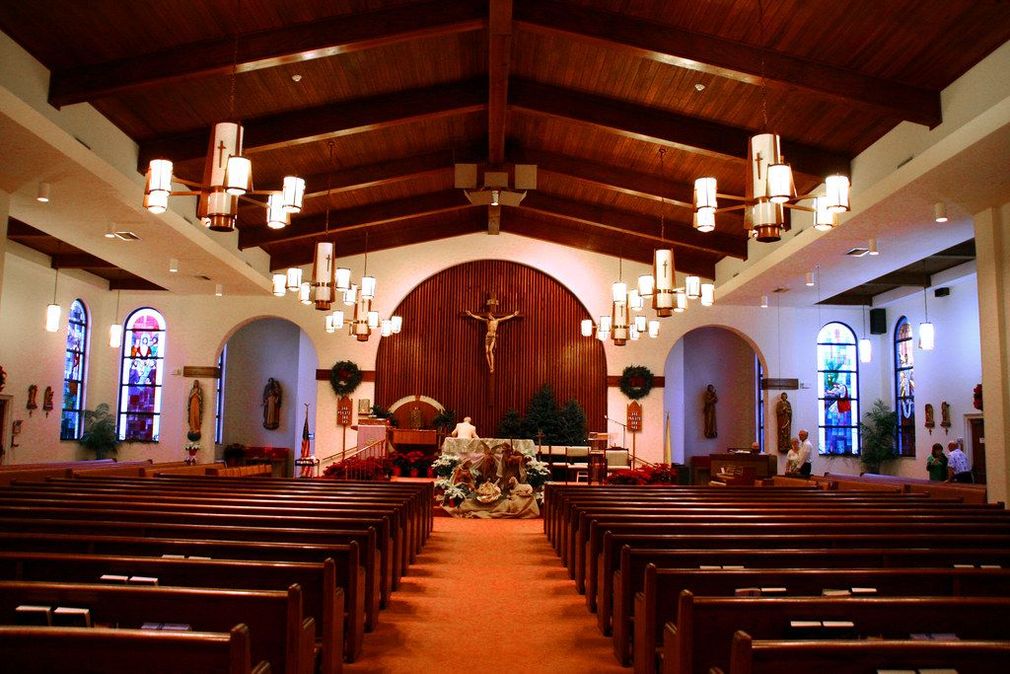
As members of the Body of Christ, the parish of St. James, Lake Placid, Florida proclaims our belief in the message and mission of Jesus Christ.
"Go, therefore, and make disciples of all nations, baptizing them in the name of the Father, and of the Son, and of the Holy Spirit, teaching them to observe all that I have commanded you. And behold, I am with you always, until the end of the age." (Matt 28:19-20)With God's Grace, the example of Jesus, and the guidance of the Holy Spirit, we seek to live out that belief as a community of worship, of shared faith and of service where each member shares with others the gifts and talents received from God.

Mass Times
Weekends
Summer Mass Schedule (June - September)
Saturday Vigil 4 PM
Sunday 9 AM
Winter Mass Schedule (October - May)
Saturday Vigil 4 PM
Sunday 8 AM and 10 AM
Weekdays (M - F) - 9:00 AM
First Saturday of Every Month
9:00 AM (with Anointing of the Sick)
Holy Days
7:00 PM Vigil, 9:00 AM Morning
Office Hours - For emergencies call 863-465-3215
9:00 am to 12 noon
12:30 pm to 3:00 pm
Wednesday
9:00 am to 12:00 noon
3380 Placid View Dr.
Lake Placid, FL 33852

Pastor, Fr. Vincent Clemente
Father Vincent came to the United States from Italy at the age of 15, where his family settled in the Cleveland, OH area. He has one sister. Father was ordained to the priesthood on May 8, 1976 and has previously served at St. Martha’s in Sarasota, FL and as pastor of St. Michael in Wauchula and St. Paul in Arcadia.

Parochial vicar Fr. Felix Gonzalez
Fr. Felix Gonzalez, our newest parochial vicar, was born in Venezuela on September 18, 1953. He studied philosophy in Trinidad & Tobago, West Indies and theology at the Seminary “Santa Rosa de Lima,” Caracas, Venezuela. He was ordained on July 18th, 1981 at the .Archdiocese of Barquisimeto. He came to the United States 20 years ago and studied monastic spirituality in Worcester, MA and worked in different parishes in the Archdiocese of New York— Manhattan and the Bronx. During those years he studied in IONA College and graduated with a Masters in Science, majoring in pastoral counseling. After serving St. Leo for almost two and a half years, he is happy to embark on this new part of his spiritual journey.
Our commitment to a Safe Environment
As Christian adults, we have a moral and legal responsibility and are entrusted by God with the spiritual, emotional and physical well-being of minors and vulnerable adults. St. James adheres to the Diocese of Venice's Safe Environment program. To learn more, visit: https://dioceseofvenice.org/offices/programs/safeenvironment/
Pope Francis' Letter to the People of God, regarding sexual abuse in light of the outcome of the Pennsylvania Grand Jury.
My Dear People,
During these first three weeks of Lent, we look at stories from the Gospel of John: 1) The Samaritan Woman, 2) The curing of the man born blind, and 3) The Raising of Lazarus represent humanity which without God is basically a sinful life like 1) the Samaritan woman whom Christ calls to salvation, 2) Humanity without Christ is blind like the man born blind who comes to the light of Christ who brings vision, which is heaven, and 3) the raising of Lazarus. Humanity is dead because of sin, and it is Christ who brings life—eternal life—to humanity.
All of us are born into spiritual blindness: original sin. The Disciples question, “Who sinned, this man or his parents?” reflects a Pharisaic belief that birth defects were the result of parental sin, or else the child himself sinned in the womb.
Jesus says, “Neither he nor his parents sinned!” Instead, this is an opportunity for God’s glory to be revealed.
“I am the light of the world,” Jesus asserts. To fully appreciate this statement, and indeed the entire account of this healing, we must notice that it occurs in a long section of John (chapter 7-9) which takes place during the Jewish Feast of Tabernacles. This resplendent festival was marked by two themes: light (Zech 14:7) and water (v8). The Temple was lit with gigantic menorahs all through the night for a week, and on the last day of the festival, water was taken from the Pool of Siloam and poured out on the altar of the Temple as a prayer for rain and as an actualization of various Old Testament prophecies of a river flowing from the Temple in the end times (Ez 47: Joel 3:18; Zech 14:14:8).
Chapter 9 ends this long section of John and draws together the themes of water and light, as Jesus uses water to bring light to this man. Obviously, water and light are connected to creation, too, because the first waters covered the deep, and then God said, “Let there be light” (Gen 1:3).
But first, Jesus spits on the ground and anoints the man’s eyes with clay.
Anointing is an important theme—Baptism is the anointing with the Holy Spirit. To this day, the rite of Baptism includes an anointing with the sacred chrism as a symbol of this reality.
What is the significance of Jesus spitting? This reflects an ancient Jewish understanding of the creation story when God spat on the ground and formed Adam’s body from the resultant clay/mud. Jesus’s spitting on the ground is a recapitulation of creation of the first man, Adam. He is re-creating this blind man, moving him from darkness (non-creation) to light (creation). He is the same God who declared long ago: “Let there be light!”
New Creation themes are presented elsewhere. After anointing his eyes, Jesus sends the man to the Pool of Siloam to wash. The pool of Siloam collected the waters of Gihon (the spring that provides water for Jerusalem). It was named the Gihon after one of the rivers of Eden (Gen 2:13) because Jews saw Jerusalem as a kind of new Eden. So, mystically, the waters of Siloam were Edenic or creational waters. The man is being cleansed anew.
After washing, he enters the light (Gen 1:3) and returns to his home. Those who know him are divided; some say he is the same man who used to beg, but others say, “No, he just looks like him.”
The man’s response—well translated here by the New American Bible Revised Edition –is ambiguous: “I am.”
“You are what? The same? Or different?”
The ambiguity is intentional because this is a baptismal catechesis. When we are baptized, do we come up as the same person as before or as a different person who just looks like the one who approached the baptismal font? The correct answer is: yes! to both. “If anyone is in Christ, he is a new creation; the old has passed. . . the new has come” (2 Cor 5:17).
Note, this is the only place in the Gospel of John where anyone other than Jesus uses the phrase, “I Am.” Having been baptized, the man participates in the divine nature. We truly begin to exist only when we enter a relationship with Christ. Life without Christ is non-existence. Darkness.
The subsequent back-and-forth with the Pharisees is darkly humorous. The statements of the Pharisees are often deeply ironic. Though physically sighted, they are completely blind spiritually. There is a progression of the man’s knowledge of Jesus through it all, till the end of the passage where he fully realizes Jesus’s divinity and worships Him. This represents our post -baptismal growth in the knowledge of Christ.
For the baptized, today’s reading should still in our hearts a profound appreciation for what has been done for us in Christ and applied to our lives through the sacraments. We have been anointed with the Spirit! If we feel very old, dim, and unspiritual, it may be that sin or distraction with the worries of this life has skewed our perspective.
Lent has three more weeks, enough time to return to Confession, increase our prayer, and increase detachment through self-denial. Then we will discover the joy of “walking in the light even as He is in the light” (1 John 1:7).
[source; Reflections on the Sunday Readings for year A by John Bergsma]
Yours in Christ.
Fr. Vincent Clemente
Upcoming Events
MARCH 9th—Monday. 40 Days for Life trip, 10AM. St. Vincent de Paul, 2PM, Social Hall. OCIA, 6PM, Social Hall.
MARCH 10th— Tuesday. Child. of Our Lady, 10AM, Social Hall. Grupo de Juan 23, 7PM, Social Hall. Knights of Columbus, 7PM, Social Hall.
MARCH 11th— Wednesday. Bible Study, 10AM, Social Hall. Divine Will Group, 4PM, Social Hall. Conf. Class, 6:30PM, Social Hall.
MARCH 12th— Thursday. Divine Mercy, 10:30AM, Social Hall. Grief Support, 2PM, Social Hall. Charismatic Prayer Group, 6:30PM, Social Hall.
MARCH 13th— Friday. Kraft Korner, 10AM-12PM, Social Hall. Soup and Stations, 5:30PM, Social Hall (hosted by Kraft Korner & St. Vincent de Paul), Youth Group, 6PM, Social Hall.
MARCH 15th—Sunday. Faith Formation, 11AM, Social Hall. Women’s & Men’s Emmaus, 2PM, Social Hall.
MARCH 16th—Monday. OCIA, 6PM, Social Hall.
MARCH 17th— Tuesday. Child. of Our Lady, 10AM, Social Hall. Grupo de Juan 23, 7PM, Social Hall
MARCH 18th— Wednesday. Bible Study, 10AM, Social Hall. Divine Will Group, 4PM, Social Hall. KOC Adoration, 7PM, Church. No Confirmation Class.
MARCH 19th— Thursday. Charismatic Prayer Group, 6:30PM, Social Hall.
MARCH 20th— Friday. Kraft Korner, 10AM-12PM, Social Hall. Soup and Stations, 5:30PM, Social Hall (hosted by Men’s & Women’s Emmaus). Youth Group, 6PM, Social Hall
MARCH 22nd—Sunday. Faith Formation, 11AM, Social Hall.